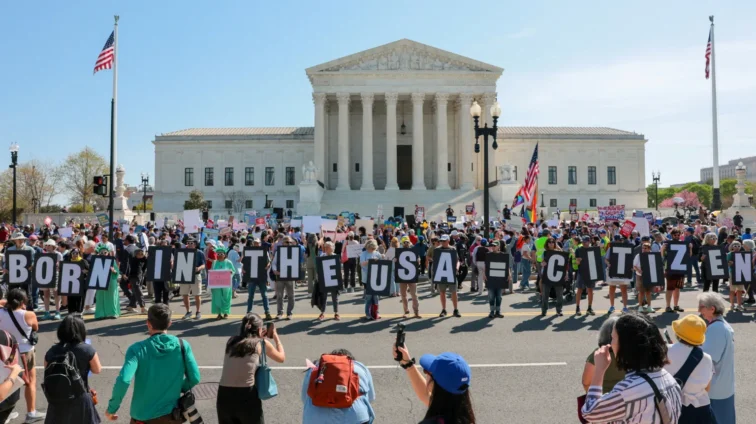
Not So Fast, Trump” – Supreme Court Side-Eyes Birthright Citizenship Ban
Justices question legality of Trump’s bold move as historic 14th Amendment battle heats up

Nelson Emmanuel
April 2, 2026 • 2 min read
AI Smart Brief
Get a quick 3-point summary of this article powered by Gemini.
The Supreme Court of the United States is giving major side-eye to Donald Trump’s attempt to restrict birthright citizenship — and it’s not looking like an easy win for the former president.
During intense oral arguments, a majority of the justices sounded unconvinced by the administration’s push to deny citizenship to children born in the US to undocumented immigrants and some temporary visitors. Translation? The court isn’t fully buying what Trump is selling.
At the centre of the drama is the Fourteenth Amendment, which guarantees citizenship to anyone born or naturalised in the US and “subject to the jurisdiction thereof.” The Trump camp argues that this clause has been wrongly interpreted for over a century — but several justices weren’t having it.
Chief Justice John Roberts, often seen as a swing vote, openly questioned how the administration plans to exclude such a broad group of people from citizenship. That alone raised eyebrows.
Meanwhile, Justice Elena Kagan made it clear: this move could flip long-standing legal tradition on its head. She pointed out that birthright citizenship is deeply rooted in history, dating back to English common law — basically saying, “why fix what isn’t broken?”
The case also leans heavily on the landmark 1898 ruling, United States v. Wong Kim Ark, which affirmed that children born in the US to foreign parents are citizens. Legal experts say if that precedent holds, Trump’s order could collapse real quick.
Even Brett Kavanaugh hinted that siding with that precedent could make this a short and decisive ruling.
Trump, in a rare move, showed up in person for the hearing — a clear sign of how high the stakes are. A loss here would mark another legal L for his administration, coming after the court already blocked his global tariff policy earlier this year.
Still, the final outcome isn’t locked in. The court could dodge the bigger constitutional fight and instead strike down the order based on a 1952 law that already defines birthright citizenship.
Either way, the decision — expected in June — could shake up US immigration policy big time.
For Trump, it’s simple: a win boosts his tough-on-immigration agenda. A loss? That’s a major setback — and a reminder that even big power moves can get checked.
Source:BBC
Comments (0)
No comments yet. Be the first to share your thoughts!